
Only 15% of corporate training produces lasting behavior change, according to the Association for Talent Development. Organizations spend an estimated $370 billion annually on workplace learning. The vast majority of it disappears within days.
This is not a budget problem. It is not a trainer quality problem. It is a design problem, and it is almost entirely preventable.
The Forgetting Curve Is Not a Mystery
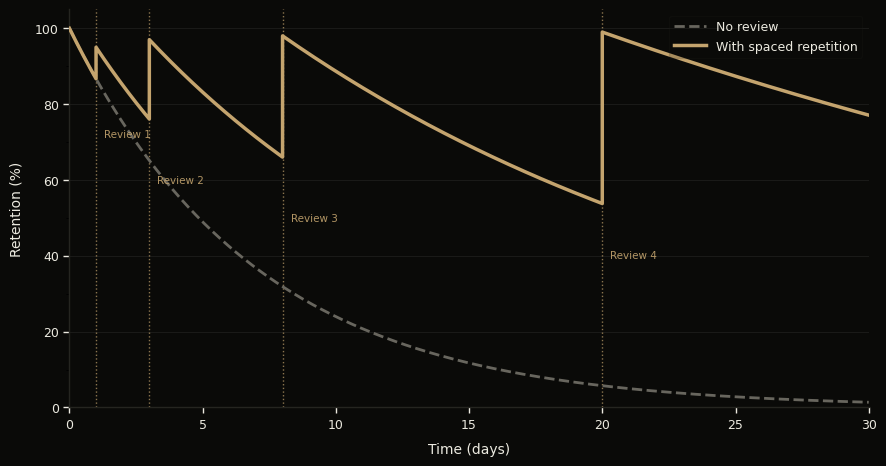
Hermann Ebbinghaus demonstrated in 1885 that humans forget approximately 50% of newly learned information within an hour, and up to 90% within a week without reinforcement. This is not emerging research. It is foundational cognitive science, and most corporate training programs were designed to ignore it.
The typical intervention, a one-day workshop, an e-learning module, a conference session, delivers content in a single burst and moves on. Retention is not designed in. Spaced reinforcement is not designed in. Practice under realistic conditions is not designed in. Then organizations are surprised when behavior doesn't change.
The Real Problem: Training Is Designed for Completion, Not Change
Most corporate training is evaluated on completion rates. Did the employees attend? Did they pass the knowledge check? Did the post-session survey show they found it valuable? These are the wrong questions.
Completion is not behavior change. Satisfaction is not skill transfer. A program can score 4.7 out of 5 on post-training surveys and produce zero change in workplace performance. Research from the Brandon Hall Group confirms this pattern: organizations that measure only satisfaction and completion have no valid evidence that anything changed.
The root cause is a design flaw. Most training targets declarative knowledge, knowing that, rather than procedural knowledge: knowing how. Recalling information in a controlled training environment is not the same cognitive task as applying a skill under real workplace pressure, with incomplete information and competing demands.
What Cognitive Science Actually Says
The research on effective learning has been consistent for decades. Three principles stand out above the rest.
Spaced practice, distributing learning across multiple sessions over time rather than concentrating it in a single event, improves long-term retention by up to 200% compared to massed practice. The spacing effect is one of the most reliably replicated findings in educational psychology.
Retrieval practice, actively recalling information rather than re-reading or re-watching it, strengthens memory traces far more effectively than passive review. Testing is not just a measurement tool. It is one of the most powerful learning interventions available.
Interleaving, mixing different types of problems or skills within a practice session, produces better transfer to novel situations than blocked practice on a single skill at a time. Real work rarely presents problems in tidy categories. Practice should reflect that.
What Effective Programs Have in Common
Programs that produce measurable behavior change share a recognizable pattern. They define the specific behaviors they are trying to change before the program is designed, not after. They build in practice opportunities that closely mirror real performance conditions. They include spaced reinforcement, follow-up activities, job aids, manager check-ins, in the weeks after the initial learning event. And they measure behavior change and performance outcomes, not just reaction and recall.
None of this is complicated. All of it requires intentional design. The difference between programs that work and programs that don't is almost never content quality. It is whether the design accounts for how humans actually learn, and retain, new skills.
A Practical Framework Before You Commission Anything
Before building or buying a training program, answer four questions honestly.
What specific behavior is this designed to change? If the answer is vague, "improve communication," "build leadership capability", the design will be vague too. Specific behaviors are observable, measurable, and designable for.
What conditions do people face when they need to use this skill? Design practice around those conditions, not idealized scenarios. A sales conversation practice that bears no resemblance to actual sales conversations will not transfer.
What happens in the 30 days after the training event? If the answer is nothing, plan for the learning to evaporate. Every program needs a reinforcement design, not just a follow-up survey.
How will you know if behavior changed? Define the measurement approach before the program launches. If you cannot answer this question, you are not ready to design the program.
The Bottom Line
The 15% figure is not a ceiling. It is the result of a design approach that prioritizes completion over change. Organizations that design deliberately, grounding programs in behavioral science rather than instructional tradition, routinely achieve far higher rates of durable skill transfer.
The gap between what most training produces and what is possible is almost entirely a design gap. It is closable. It just requires designing for the right outcome from the start.
If your training programs aren't producing the outcomes you need, Navilo can help you understand why, and design something that does. Start the conversation here.